Staff Special: Crypto Mining @Home — Level 2: Mining on a Condo Balcony


Miner Profile


Materials Needed


The Process


Most people have an outlet like this on their balcony

My outlet looks more like this


This is what the inside looks like with the lid open


Disclaimer


Picture of ePIC Blockchain Technologies

ePIC Blockchain Technologies

Writer for ePIC Blockchain Technologies

Staff Special: Crypto Mining@Home — Level 1

In this blog post, an ePIC staff member shares her at-home mining experience. For clarity in this blog post, people or entities who are mining crypto are referred to as “miners”, and the machines that solve the algorithmic puzzles to earn the crypto are referred to as “rigs”. The intended audience for this post is the novice hobbyist who wants to start mining with the SC200.

Miner Profile

Name: Juno

Job: Marketing Staff at ePIC

Mining Experience: 5 months

Motto: It’s NEVER too late to start!

I have been in the industry for a year now since I have joined ePIC. As a newbie to the crypto scene, I thought it would be helpful for any aspiring home-miner to showcase my experience mining with SC200 Siacoin miner.

SC200 is a mining rig that mines coins on the blake-2b algorithm. For more information, visit epicblockchain.io

Electrical Requirements

This is probably the most math-intensive part of this blog. Before you even turn on the machine, first figure out the specifications of your electrical outlets.

Most homes have multiple outlets connected to one breaker. Traditional breakers can range from 10A to 20A in residential settings and different regions of the world have different AC Voltages ranging from 120V to 240V.

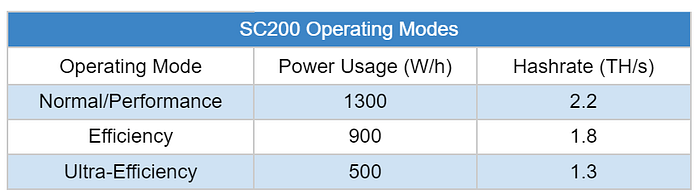
Then, it would be helpful to understand the miner’s power usage which can be found in the product specifications:

Note: the specs are subject to +/- 10% deviation.

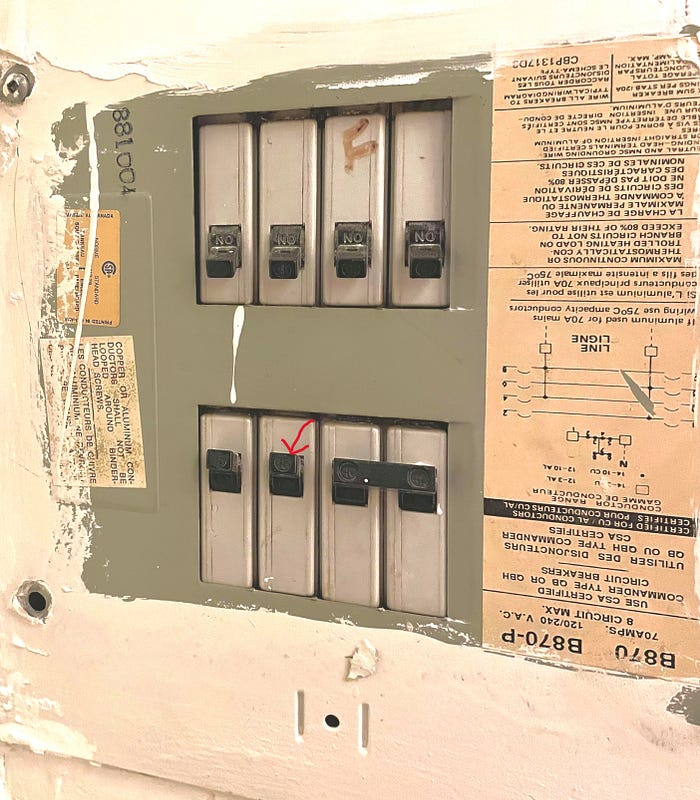
I also had to find out the electric current of each outlet by looking at the breaker. The numbers are typically labeled on the switch:

The first step is to calculate the wattage (or power), that the outlet can tolerate. The outlet I chose to plug the rig into was 20A. The max wattage is calculated with this formula:

P is the power consumption measured in watts (W), I is the electric current of the circuit measured in amperes (A), and V is the voltage measured in volts (V). The voltage in North America is 110 V.

My particular outlet can support the SC200’s highest operating mode, which is about 1300 watts.

If you have small appliances plugged into the same breaker, you may still be able to plug in your rig depending on the performance mode you choose. You need to ensure that the total power does not exceed the maximum wattage for the outlet.

For instance, if you have a hair dryer that uses 1000W and your outlet is 20A, and the voltage is 110V. Your rig can only go up to 1200W or otherwise, you would trip your breaker.

Setting Up the Rig

Instructions are available online and they are easy to follow. Basically, all I had to do was plug in a few wires and the rig would start running. It took about 15 minutes for the rig to calibrate, during which the fans can be a little loud. But once the machine has been calibrated, the fans will adjust according to your power setting.

Setting up Rig Configuration

I used the ePIC Dashboard to manage my rig. With the dashboard, I can tell the rig what mining pool to use, what wallet to mine to, and what mode to operate in. The SC200 does have periodic firmware and dashboard updates so be sure to check GitHub or your inbox for updates. Overall, it was pretty easy to set up. For SC200 users, you can email support@epicblockchain.io if you run into any issues.

Mining Pool

I personally use Luxor as my mining pool since they have a Bitcoin conversion product called Catalyst. If you would like to hold Sia, you can use other pools like siamining.comf2pool, and DxPool.

Wallet

There are a few wallets that support Siacoin: SiacentralSia UI, and Ledger Nano S just to name a few.

Noise Level

As the power consumption goes up, the rig works harder, and the fans in the rig turn faster, resulting in an increase in noise level. In the 500W Ultra-Efficiency mode, which is the mode that I am personally comfortable with mining in my studio apartment, the noise level is negligible. If you put the rig in Efficiency mode in a separate room like a guest bedroom, you probably won’t be able to hear the rig unless you are Dolores from the Disney Movie Encanto.

Ease to Adjust Power Settings

With the ePIC dashboard, I could adjust the performance mode very easily. Sometimes I bring the operating mode up to 1000W Efficiency mode when I am not home (because of the fan noise) and down to 500W Ultra-Efficiency mode when I am home. Hopefully a scheduling mode will be added in the future to automate this process even further.

Electricity Cost

For me, a monthly cost of $30 CAD covers the electricity for mining, but if you are a renter and your utility fees are all included in your maintenance fees, then that’s even better! Go crazy on mining (but please don’t burn your home down).

Final Comment

The ePIC SC200 has been an effortless rig to use for home-mining. It doesn’t require getting electrical work done to operate if you are only running a few rigs, spreading things out in different outlets. If you are new to mining, the setup is foolproof. For me, the SC200 was very easy to navigate and allows for flexible options for a new home miner like me.

Disclaimer

By using this website and or blog, the user agrees as follows:

The information given to the user with the understanding that neither the author nor publisher is engaged in rendering any legal, business, or financial advice to the purchaser or to the general public. The views and opinions expressed are those of the authors and do not necessarily reflect the official policy or position of ePIC Blockchain. Any content provided by our bloggers or authors are of their opinion and are not intended to malign any religion, ethnic group, club, organization, company, individual or anyone or anything.

Although we make strong efforts to make sure our information is accurate, ePIC cannot guarantee that all the information on this website and or blog is always correct, complete, or up-to-date.


Picture of ePIC Blockchain Technologies

ePIC Blockchain Technologies

Writer for ePIC Blockchain Technologies

ePIC Blockchain’s Next CEO Focused on Execution and Growth

Pairing strong execution and innovation is how ePIC can harden its trajectory to becoming a premiere hardware supplier in the blockchain ecosystem. To that end, ePIC is pleased to announce that Jim Seto will be joining the Board of Directors and stepping up from his current Chief Operating Officer (COO) role to become the next Chief Executive Officer (CEO) of ePIC Blockchain.

Seto said, “The past two years have been an exciting time for ePIC Blockchain Technologies. It has been a privilege to work with the angel investors and with the core team members. Completing the ASIC miners, going to market, and generating a revenue stream in an early seed stage is a reflection of the company’s potential. The next growth phase for ePIC promises to be more spectacular and I look forward to executing our ambitious goals.”

In the fabless semiconductor industry, Jim is recognized as a domain expert in setting up and building robust execution engines that drive product delivery, from product concept to full production. His three decades of experience from his time at QualcommAMD, and ATI, will position ePIC well for the rapid growth in blockchain hardware infrastructure.

The skillset of his semiconductor expertise and operational acumen will lead ePIC into the emerging growth phase of the enterprise. This transition has already begun and will be completed over the next 30 days.

Henry Quan will carry on as ePIC’s Chief Marketing Officer (CMO) and will continue to focus on business development, sales, and marketing deliverables for ePIC. The Board of Directors thanks Henry for bringing the team together and providing leadership and guidance over the past three years.

“With his extensive industry experience, Jim will ensure ePIC delivers to its customers by managing product execution and building critical partnerships. Under Jim’s leadership, ePIC is well-positioned for its next phase of growth. As a fabless start-up in North America, ePIC Blockchain can focus on its customers, the end market opportunities, and innovative products. The GSA (Global Semiconductor Association) looks forward to supporting the ePIC team, as it executes on its vision,” said Jodi Shelton, the CEO and Co-Founder of Global Semiconductor Association.

About ePIC Blockchain
ePIC Blockchain is North America’s only Cryptocurrency ASIC and Mining Rig supplier. ePIC’s engineering team has developed semiconductor technology for many popular products over the past decade including 10 generations of AMD GPUs and 6 generations of GPU IP for game consoles including the Playstation 4 and 5.

ePIC makes superior products for Altcoin mining. ePIC is currently shipping SC200 Mining Rig for Siacoin and has 2 ASIC Mining Rigs slated for release during 2021. For more information, please visit www.epicblockchain.io

Contacts
ePIC Technologies
info@epicblockchain.io


Picture of ePIC Blockchain Technologies

ePIC Blockchain Technologies

Writer for ePIC Blockchain Technologies

Argo Blockchain Inks Collaboration Deal with ePIC Blockchain

Argo Blockchain PLC(LON:ARB) said it has signed a commercial supply and collaboration deal with ePIC Blockchain Technologies which it said will allow it to receive priority access to state-of-the-art ASIC mining machines.


The cryptocurrency mining firm said as part of the deal it has committed to an initial purchase of US$8mln of ePIC’s mining rigs and will have priority on all future production runs of ePIC machines globally for 2021 and 2022. Delivery of the machines will begin early in the fourth quarter of this year, while larger-scale delivery will commence in 2022.


READ: Argo Blockchain value beyond US$1bn as bitcoin rise continues


Argo also said it will assist in the development and testing of future products and will be given the first right of refusal to purchase additional production. The company added that it will provide space and capacity at one of its facilities for ePIC’s research and innovation engineering teams for the development of future machines.


Based in North America, ePIC has experience in high-performance computing, parallel processing, and power efficiency and has designed and delivered semiconductors for firms such as Sony, Nintendo and Microsoft Corp (NASDAQ:MSFT).


“This will be a game changer for Argo and ePIC. We are excited with the synergy between our teams. With the expertise of ePIC on the chip side combined with the mining capabilities of Argo, we truly believe this will enable us to be at the cutting edge of mining, from chip to data centre,” Argo’s chief technical officer Perry Hothi said in a statement.


“We are really excited about this agreement and working with ePIC, one of the industry’s preeminent ASIC design firms. This partnership will not only give Argo priority in accessing the most advanced mining infrastructure available, but it also highlights our reputation within the sector as an innovative and forward-thinking cryptocurrency miner. By working with a world-class supplier of ASICs at the development and [research & development] phase to collaboratively create machines to our own specification, it will only further our technical capabilities and efficiency in our mining operations,” added Argo chief executive Peter Wall.

What It Takes to be a World-Class ASIC Hardware Provider

The recent pandemic has made us look at things differently, focused our attention on critical infrastructure, and forced us to adapt to new challenges. As a response, old ideas have come back in fashion again showing how foundationally important they are. While new ideas have accelerated ahead spurring on important innovations.

Take for example virtual home workouts. Exercise is an enduring element of daily life. New workout routines and training programs have been created for home, but delivered interactively and streamed in real time. The content might be new, but adoption and success of this new paradigm depends on fast and reliable internet access. Internet access has never been more crucial — so much so, that it is a de facto essential service.

Good system design will lead to dependable infrastructure that is reliable and robust.


Emerging blockchain hardware: ASIC mining

In response to cryptocurrency markets, various companies, often with inadequate experience, have produced ASIC miners. In the rush to capitalize on the market, robust system design is often an afterthought by some companies. There could even be an argument that this aspect is completely overlooked. Producing an ASIC is more than just writing a few lines of code.

The adoption and success of a mining operation depends on full-system thinking, end-to-end reliability, and close collaboration with mining farms.

Who can step up to these challenges?


Some of the recent ASIC hardware providers have been struggling with poor integration into the mining infrastructure, field failures and major gaps between specifications and real-life results. While others have just disappeared.

But there are also new players emerging.


Introducing ePIC Blockchain Technologies


This brings us to a promising North America based start-up, ePIC Blockchain Technologies.

This high performance, experienced team applies the best practices for engineering design and operational excellence from the telecom, PC and mobile industries to the ASIC hardware mining space.

SoC design and system design are highly specialized fields of engineering. Combining these specialized design skills with a deep understanding of architectural trade-offs and blockchain algorithms is the recipe for success.

At its core, this is the team inside ePIC.

To date, the industry has been preoccupied with nano-marketing name dropping. It is fashionable for companies to tout their ASIC based on the technology node. However, that may be a distraction from what is lacking.

The end-customer should not care which node their ASIC is manufactured on. What matters is the quality of the design.

The proliferation of multiple variants, 5–6 in some cases, of a manufacturer’s product is another interesting artifact of the current suite of mining providers. Is it a deliberate marketing plan for different price-points? Or is it a design and manufacturing flow that is not well understood and controlled? Could it be a very wide cross-section of performance and power outputs that are produced and pushed out to the unsuspecting customer?


What really matters to the ASIC mining customer?

The answer is simple. Get the job done right and on-spec.

Launched recently, the SC200 miner is the product that showcases ePIC’s world-class system design capabilities.


From ASIC to mining rig: a visual glimpse into bringing a product to market

Work doesn’t stop just because silicon is in hand.

Full understanding of the system is required to bring a quality product to market. Having a chip that works in isolation is not enough. Having both the depth and breadth is what distinguishes ePIC from other companies.

Here are a few examples of the behind-the-scenes due diligence taken prior to the introduction of the SC200 to the market. And it serves as a macro lens into the systematic approach that is needed for future generations of ASIC hardware miners.


Socket testing for full characterization of SoC

Initial socket testing for full characterization of SoC followed by Individual hashboard testing for performance and power validation

Simulated heat-map of chip substrate to model on-die IR drops. Advanced 3D modelling of heatsink and chip positioning

Mechanical design and modeling including 3D modeling of the enclosure to study fan requirements and airflow dynamics

Polycarbonate case to study thermal losses and mechanical fitment

Infrared imagery to validate results

Fan and airflow validation with a thermal load
(yes, that is the heating element of a 1200W hairdryer)
Calibration of temperature ramp on a per chip basis to validate heat transfer characteristics of a hashboard. This is done in an immersion tank to measure the profiles in a controlled environment.

Leading the way

In any industry, what distinguishes the leaders is straight forward — “what they deliver just works as advertised”.


ePIC Blockchain Technologies is bringing this philosophy and track record to the ASIC hardware blockchain mining industry. World-class engineering design and a maniacal focus on operational excellence are ingrained in the ePIC culture.

To be called out so early as the “Dyson of ASIC Miners” is a distinction to be proud of and the team will press on to provide dependable, robust, and reliable technology.


Picture of Jim Seto

Jim Seto

CEO, ePIC Blockchain Technologies
Writer for ePIC Blockchain Technologies

Navigating Mining Options for the Ethereum Classic SHA-3 Fork


This article is a synopsis of the whitepaper, 
SHA-3: Impact on Ethereum Classic Mining Hardware & Network Security 
posted on ePIC Blockchain’s Github.

The Ethereum Classic (ETC) community has been embroiled in a proposed Proof of Work (PoW) change to increase network security. ETC was attacked twice in January of 2019. To bolster the security of the ETC network, the ECIP 1049 proposal, initiated by Alex Tsankov, advocates changing ETC’s PoW algorithm to SHA-3 (also interchangeably referred to as Keccak). Significant effort has been devoted to testing with SHA-3 on Astor.net, the testnet for Ethereum Classic.

ECIP 1049 will create new ways to interact with the blockchain while also improving its integrity and security. Becoming the largest blockchain on the SHA-3 algorithm greatly reduces the chance of bad actors attacking the ETC network while fostering a whole new generation of mining hardware development and innovation.


SHA-3 is hardware agnostic

Network hashrate and, moreover, network security relies heavily not only on miners but loyal and dedicated miners who truly support the network. Changing to ECIP 1049 will lead to an increased hashrate and more diverse mining hardware including dedicated hardware for ETC in the form of ASICs. This will make the ETC network significantly more resilient to GPU (Graphics Processing Units) attacks.


While the change significantly improves network security, there were concerns from the community that dedicated ASIC hardware would not be ready for the Block 11.5 million hard fork to the SHA-3 PoW. These concerns are unfounded since SHA-3 is hardware agnostic and will run on today’s GPUs and FPGAs (Field Programmable Gate Arrays) until SHA-3 ASICs come online.


In other words, a fork to SHA-3 would be an easy transition for current GPUs mining on the ETC network.


The proposal would not only increase the hardware options for miners but allow ETC to be the dominant mining network on the SHA-3 algorithm, unlike ETC on Ethash today. Increasing the hashrate makes a network more difficult to attack. An attack requires many devices to be amassed. Renting hardware may be an option, but the high cost of rental makes this an unlikely option.

Other networks have successfully used a similar strategy, that is staying hardware agnostic, for their PoW algorithm. As an example, Grin coin, which uses the Cuckatoo 31 and 32 algorithms, is being mined with GPUs, while ASICs are being developed. However like Ethash, Cuckatoo is memory bound and therefore not conducive to FPGA mining.


Abundant FPGA support for SHA-3

Software infrastructure to support SHA-3 mining already exists today for GPUs and FPGAs from a variety of smaller Alternate Coins (Altcoins). These include SmartCash and 0xBitcoin. ETC can easily leverage these existing infrastructures to become the dominant SHA-3 network, thus reducing the risk of GPU miners shifting networks as profit changes, and potentially compromising network security. SHA-3 software infrastructure has been used since July of 2017. The ETC community can take comfort in the stability of the infrastructure and the availability of community support.


The fork to SHA-3 would attract significant interest from FPGA miners. With over $70 million of mining rewards, ETC would represent the largest network that is profitable to mine with FPGA devices.


Various FPGA miners available from FPGA.guide
 

Network security increases with FPGAs

ePIC Blockchain estimates that there are about 800,000 GPUs mining ETC today. While this seems like a large number, the number of GPUs that are mining Ethereum today is above 6 million. Converted to SHA-3 hash power, the current ETC GPU miner base would produce about 270 TH/second of hash power. The migration of only 15,000 FPGAs to ETC mining would double the projected hash rate to 540 TH/second.


While FPGA miners are nomadic in nature, constantly moving to the most profitable network, they are unlikely to amass enough hashrate to attack the ETC SHA-3 network. By my estimates, it would cost over $1 million per day to rent enough FPGAs from AWS F1 to mount a 51% attack on ETC network when it is being secured by 800,000 GPUs and 15,000 FPGAs. Alternatively, it would take 1.5 million GPUs to amass such an attack. (The numbers used in this post is based on a conservative ETC price of $7.85; ETC is currently trading around $12. Therefore, this allows for some interchange among the miner base between GPU and FPGA based on profitability.)


The ASICs are coming

The absence of ASICs at the start of the SHA-3 fork should not be a concern to the ETC community. Since bringing ASICs to market requires time and large investments, ASIC providers require certainty before committing resources.The rewards from mining along with the coin emission rate make bringing SHA-3 ASICs to market very attractive. Given ECIP 1049’s current timeline, there is adequate time and existing hashrate to support the network until the arrival of ASICs. Both GPUs and FPGAs will be used to mine at the inception of SHA-3 on Block 11.5M.


Relative characteristics of SHA-3 mining hardware. Source: ePIC SHA-3 whitepaper


As SHA-3 ASICs come online on the ETC network, the security of the network will be greatly enhanced. ASIC hash rates are expected to be 7 to 400 times the hashrate of current FPGAs and GPUs. The huge increase in hashrate essentially removes the threat of a 51% GPU attack. ASIC miners by their nature are dedicated machines devoted to a single algorithm like SHA-3 and therefore have no motivation to attack their primary network. An attack would jeopardize the future profitability of one’s ASIC mining hardware.


Detractors of ECIP 1049 are attempting to derail adoption of SHA-3 by asserting that SHA-3 ASICs are difficult to design and implement. The fact is, the design is simple. There are many SHA-3 ASIC design papers published and several open source designs are available as a starting point. By comparison, there are no open source Ethash ASICs or FPGA bitstreams. The naysayers are Ethash ASIC manufacturers who have a vested interest in preventing ETC’s hard fork, since their ASICs are unable to mine SHA-3.


SHA-3 Activation Plan

In order to ensure a smooth transition at Block 11.5 million, the ETC community needs to ensure that there are several viable options for mining available from the start. With the ETC Astor Testnet already live today, the community can rally together to provide a working infrastructure. Reaching out to popular GPU software miners and FPGA developers as early as possible will greatly help the efforts of the proposed ECIP 1049 transition.


Summary & call to action

The ECIP 1049 proposal represents a great opportunity for the ETC network. Fundamentally, it is an initiative to secure the network by greatly increasing the hashrate and diversifying the pool of mining hardware. Hardware innovation and development will follow as ETC mining evolves towards FPGAs and ASICs. Adoption of this proposal will push the ETC network to the forefront of the SHA-3 mining ecosystem and out of the shadows of Ethash.


Be ready for the SHA-3 transition by October 2020.


Further discussion on network security, network hashrates and SHA-3 hardware can be found in a whitepaper on ePIC’s Github, SHA-3 Transition Whitepaper: Impact on Ethereum Classic Mining Hardware & Network Security. The data and rationale used in this post is explained in more detail in the whitepaper.

Post your feedback below. Follow me for future mining and ASIC hardware insight.

Picture of Henry Quan

Henry Quan

Blockchain Hardware Expert
Writer for ePIC Blockchain Technologies