
Every watt an ASIC consumes becomes heat, and how efficiently a facility removes that heat determines how hard the hardware can run, how long it lasts, and how many units fit in a given space. Cooling is not a secondary infrastructure decision. It shapes hashrate density, effective efficiency, maintenance load, and the total capital required to bring a site online.
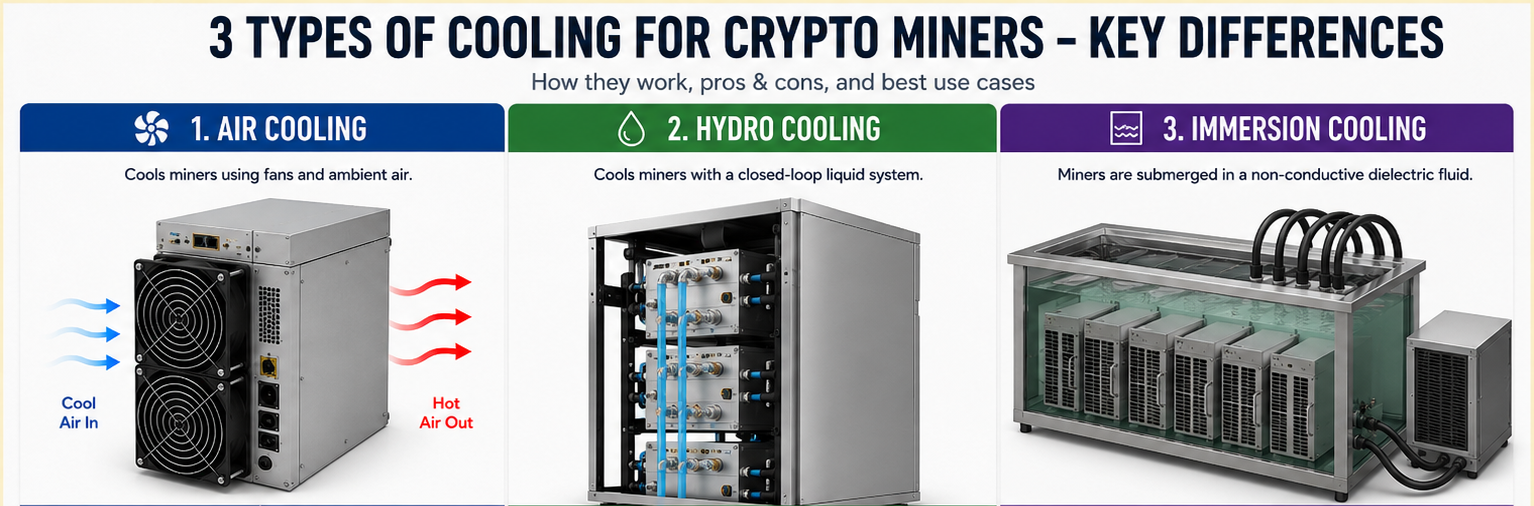
Three cooling methods dominate enterprise Bitcoin mining today: forced-air cooling, hydro (direct water) cooling, and immersion cooling. Each carries a different balance of upfront cost, operational complexity, thermal performance, and hardware compatibility. This post compares the three across the factors that matter at scale, explains where each fits, and covers the firmware considerations that apply once a facility moves beyond stock air cooling.
The specific efficiency and hashrate figures below are approximate and drawn from current-generation hardware and operator reports. Cooling performance varies with ambient conditions, fluid type, hardware generation, and tuning, so verify against current Bitmain published specs and your own measurements before committing capital.
The Common Problem: Heat Is the Constraint
A modern ASIC concentrates several kilowatts of power into a small chassis. An air-cooled Antminer S21-class unit draws roughly 3,500 watts; a hydro-cooled S23-class unit can draw around 11 kW in its densest configuration. Nearly all of that energy exits as heat, and the rate at which cooling can carry it away sets the ceiling on sustained performance.
When chips run hot, two things happen. Performance throttles to stay within thermal limits, reducing the hashrate the operator actually earns from. And sustained high temperatures accelerate hardware aging, shortening the useful life of an expensive fleet. The physics driving the three cooling methods is straightforward: liquids conduct heat far more effectively than air. That single property, direct-contact liquid heat transfer, is why hydro and immersion can push hardware harder than air can, and it is also why they cost more to build.
The right method depends on the operation’s scale, location, climate, power cost, capital position, and tolerance for infrastructure complexity. There is no single best answer, and the tradeoffs are real in both directions.
Air Cooling: The Established Default
Air cooling moves ambient air across the hashboards via onboard fans, carrying heat out of the chassis and into the facility, where it is then exhausted. It is the method the overwhelming majority of deployed mining hardware uses, and stock Antminers ship configured for it.
The advantages are practical. Air-cooled hardware has the lowest upfront cost and the simplest installation. A standard air-cooled S21 XP runs on 220–277V single-phase power and requires nothing beyond electricity, network, and adequate airflow. There is no coolant loop, no distribution unit, no plumbing, and no fluid to manage. For operators adding capacity to an existing air-cooled facility, or building where capital is constrained, air remains the path of least resistance.
The constraints are equally real. Fans consume power without contributing to hashing, and they are among the most common mechanical failure points on a miner. Air pulls dust and airborne particles across the heatsinks, which accumulate over time and degrade thermal performance. Air-cooled facilities are loud, with full-size units running around 72–76 dB, roughly the volume of a vacuum cleaner. And air struggles in hot climates: as ambient temperature rises, the cooling headroom shrinks, and throttling becomes more frequent. Density is limited too, since each unit needs airflow clearance, which caps how much hashrate fits per rack and per square foot.
For current-generation hardware, the most efficient air-cooled option is around 13.5 J/TH (for example, the Antminer S21 XP at approximately 270 TH/s), with workhorse models like the S21 Pro closer to 15 J/TH. These figures are approximate and should be verified against current Bitmain specs.
Hydro Cooling: Direct Liquid Through Sealed Loops
Hydro cooling circulates water or a water-based coolant through sealed blocks in direct thermal contact with the hashboards. Heat transfers into the liquid, which is pumped to an external heat exchanger or dry cooler, released, and recirculated. Unlike immersion, the miner is not submerged; the coolant runs through a closed internal loop, and the hardware is purpose-built for it.
Hydro’s strength is density and thermal stability. Because liquid carries heat away so effectively, mining rig manufacturers can pack far more hashing power into a hydro chassis than an air-cooled one of the same chip generation. The hydro-cooled S21 XP Hyd delivers roughly 473 TH/s at approximately 12 J/TH, compared with about 270 TH/s at 13.5 J/TH for the air-cooled S21 XP built on the same silicon. The newer S23 Hydro reaches approximately 9.5 J/TH, the most efficient current-generation tier, though at a substantially higher price. The liquid loop holds chip temperatures steady regardless of ambient weather, so a hydro unit sustains rated speed through summer peaks that would throttle an air-cooled machine. Hydro units are also dramatically quieter, often around 50 dB versus 75+ for air. (All specs approximate; verify against current Bitmain datasheets.)
The cost is infrastructure. Hydro requires a coolant distribution unit (CDU), plumbing, a heat exchanger or dry cooler, and typically three-phase power in the 380–415V range for the highest-density units. This buildout can cost as much as or more than the miners themselves, and it is not plug-and-play. For a facility standardizing on liquid cooling from the design stage, hydro is a coherent choice. For an operator adding a few units to an air-cooled hall, the infrastructure overhead usually outweighs the efficiency gain, and current air-cooled hardware often delivers better economics. The chip-level efficiency advantage over the best air-cooled models is real but, for the closest comparisons, relatively modest; the larger wins are density, noise, and thermal stability.
Immersion Cooling: Full Submersion in Dielectric Fluid
Immersion cooling submerges entire miners in a non-conductive (dielectric) fluid, typically a mineral oil in single-phase systems. Every surface of every chip, capacitor, and board is in direct contact with the fluid, which absorbs heat uniformly and circulates to a heat exchanger before returning to the tank. Fans are removed entirely.
Immersion’s appeal is the combination of overclocking headroom, hardware protection, and uniform cooling. Because the fluid extracts heat evenly across the board, without drastic hot-spot gradient, operators can run chips harder than air allows. Operator reports and third-party firmware data generally cite defensible sustained hashrate gains in the range of approximately 20–40% above stock when overclocking under immersion, with chips running roughly 20–30°C cooler. Some vendor sources claim 25–55%, which should be treated with more caution, as the upper end reflects favorable conditions and marketing framing rather than typical sustained results. On a 200 TH/s unit, even a 20% overclock adds around 40 TH/s from the same hardware, though power draw rises with clock speed, so the economics depend on the operator’s power rate rather than hashrate alone. Efficiency (J/TH) can improve modestly under immersion, often in the single-digit to roughly 10% range, because cooler chips run more efficiently and fan power is eliminated. Larger energy-reduction claims exist but are not well substantiated and should be verified independently.
Immersion also removes dust, corrosion, and fan failures from the equation, which can extend hardware life, and it is quiet. The tradeoffs are the most demanding of the three. Immersion requires tanks, dielectric fluid (a real ongoing cost), pumps, heat exchangers, and a facility designed around fluid handling. Hardware must be prepared for immersion (fans removed, warranty implications), maintenance means working with fluid-covered equipment, and the upfront complexity is the highest of any method. It suits new facility builds where the infrastructure can be designed in from the start, and operators specifically pursuing maximum hashrate density and overclock headroom.
Side-by-Side Comparison
The table below summarizes the three methods across the factors that drive the decision. Figures are approximate and generation-dependent; verify against current hardware specs and your own site conditions.
| Factor | Air Cooling | Hydro Cooling | Immersion Cooling |
| Upfront infrastructure cost | Lowest | High (CDU, plumbing, dry cooler) | High (tanks, fluid, pumps) |
| Installation complexity | Simplest | Complex | Most complex |
| Power requirement | 220–277V single-phase (typical) | Often 380–415V three-phase | Varies by build |
| Hashrate density | Lowest | High | High |
| Overclocking headroom | Limited | High | High |
| Chip temperature stability | Weather-dependent | Very stable | Very stable |
| Noise | Loud (~72–76 dB) | Quiet (~50 dB) | Quiet |
| Dust / corrosion exposure | High | Very low | Low |
| Ongoing consumables | Fan replacements | Coolant maintenance | Dielectric fluid |
| Best fit | Capital-constrained, existing air halls, cooler climates | Purpose-built liquid facilities, hot climates, high density | New builds, maximum density and overclock |
Where Firmware Fits Across All Three Methods
Cooling determines how much thermal headroom the hardware has. Firmware determines how effectively the operation uses it. This is where the two decisions connect, and it applies regardless of which cooling method a facility chooses.
Stock Bitmain firmware applies fixed, conservative operating parameters intended for stability and warranty compliance under standard air cooling. It does not adapt to the additional thermal headroom that hydro or immersion provides, and it offers limited programmatic control. When a facility invests in liquid cooling specifically to run hardware harder, stock firmware leaves much of that headroom unused because it was not built to take advantage of it.
Custom firmware such as UMC OS replaces the stock firmware and adjusts operating parameters, per-chip frequency and voltage, to match the actual thermal conditions the hardware is running in. In an immersion or hydro environment where chips stay cool and stable, this allows the fleet to sustain higher performance safely, rather than running conservative presets designed for a hotter air-cooled worst case. UMC OS supports immersion cooling mode and makes the most out of submerged deployments.
The tuning behavior matters most where thermal conditions change. UMC OS’s Perpetual Tune runs continuous closed-loop optimization, monitoring temperature, hashrate output, and frequency response, and making incremental per-chip adjustments over time. Its thermal protection throttles performance when the chip temperature approaches 2°C below the shutdown threshold, and gradually restores performance once the temperature drops to 7°C below that threshold. In air-cooled facilities where ambient temperature swings across seasons, this adaptation keeps the fleet operating near its thermal envelope without manual reconfiguration. In liquid-cooled facilities, the stable thermal floor lets the tuning settle at a higher sustained operating point. You can read more about how these algorithms work in the tuning algorithms article.
The Environmental Framing: What the Data Supports
Flare gas mining attracts both strong advocacy and significant skepticism on environmental grounds. The actual environmental calculus is more specific than either position typically acknowledges.
Methane — the primary component of natural gas — is a significantly more potent greenhouse gas than carbon dioxide over a 20-year period. When gas is flared, the methane is combusted and converted primarily to CO2 and water vapor. Flaring is environmentally preferable to venting raw methane directly. Mining operations that capture gas and run it through a generator also combust the methane, producing CO2 — a similar outcome to flaring in terms of methane conversion, with the addition of electricity generation.
The meaningful environmental argument for flare gas mining is not that it eliminates emissions but that it converts unavoidable emissions into something economically productive, which creates a financial incentive to capture gas that would otherwise be vented or flared inefficiently. In regions where flare gas regulations are weakly enforced, the economic incentive of mining revenue may produce better compliance with gas capture requirements than regulation alone.
The weaker version of the environmental claim — that Bitcoin mining powered by flare gas is “carbon negative” or “carbon neutral” — is not supported by the emissions arithmetic. Operators making this claim publicly should be prepared to support it with verified emissions data, because it is the most scrutinized assertion in the Bitcoin mining ESG conversation.
ePIC’s own hardware reflects this cooling-integrated approach. The BlockMiner 520i was designed as an immersion-ready unit with native UMC integration and real-time voltage and frequency modulation, and the BlockMiner 740a as an air-cooled 4U unit for data center environments, both illustrating how firmware-level control pairs with a specific cooling design. (Both are currently sold out; they are referenced here as design examples rather than available products.)