

Stock Bitmain firmware provides stable, out-of-the-box performance based on Bitmain’s factory-tested specifications. Custom Antminer firmware — such as UMC OS, Braiins OS+, LuxOS, and VNish — is designed to make it flexible for your specific operation. That difference sounds simple, but it has real consequences for efficiency, hashrate, and mining ROI that compound significantly at scale.
This guide breaks down exactly what separates stock from custom firmware, where the efficiency gaps come from, and what operators running S19x through S21x fleets should understand before making a firmware decision.
What Is Stock Antminer Firmware?
Stock Antminer firmware is the default firmware that Bitmain installs on its mining hardware before it leaves the factory. It controls the operating frequency, voltage, fan behavior, and thermal thresholds of each miner. Bitmain engineers it to a conservative middle ground: it prioritizes achieving name-plate specs, warranty coverage, and safe operation rather than peak efficiency for any specific one.
The result is firmware that ships with fixed or limited performance presets — typically a small number of preset power modes (such as low, normal, and high) — with no per-chip tuning, no automated self-optimization, and no external API access for fleet control. For a single miner in a home setup, this is adequate. For an enterprise fleet running hundreds of Antminers, it leaves a significant amount of performance and profitability unrealized.
What Is Custom Antminer Firmware?
Custom Antminer firmware replaces the stock control firmware with a third-party build that can read hardware state at a granular level and adjust operating parameters in real time. Rather than applying one setting to all chips on all hashboards, custom firmware treats each chip as an individual unit — adjusting its clock frequency and voltage independently to find the most efficient operating point.
The key capability that separates custom firmware from stock is dynamic per-chip or per-board tuning. Instead of a fixed preset, custom firmware continuously adjusts as conditions change: ambient temperature shifts, hashboards perform unevenly, and power prices fluctuate. This makes custom firmware particularly valuable for large-scale operations where no two miners behave identically after months of continuous operation.
Stock Firmware vs. Custom Firmware: A Direct Comparison
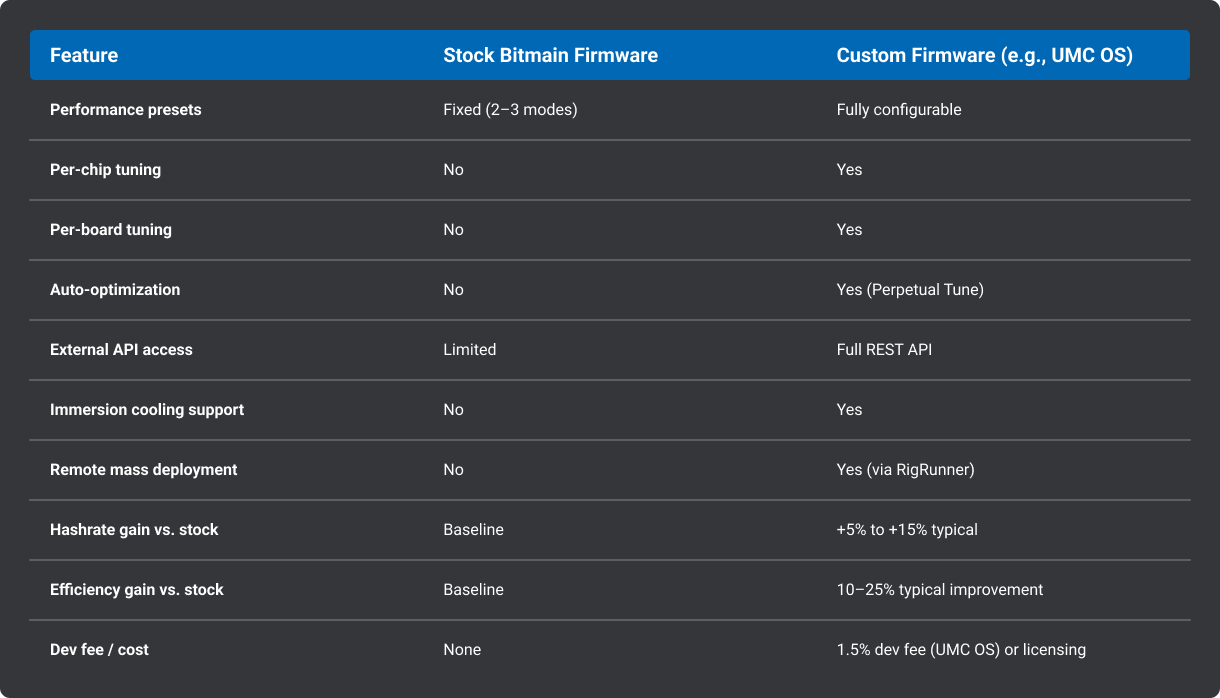
Where Do the Efficiency Gains Actually Come From?
The efficiency gains from custom firmware come from three sources, and understanding each helps operators assess how much they stand to gain.
1. Voltage optimization across chips
Every ASIC chip on a hashboard is slightly different due to manufacturing variation. Stock firmware applies one voltage setting across all chips to ensure the weakest chip on the board can operate without crashing the whole system. Custom firmware first tries a stable voltage that is generally safe for all chips, then gradually lowers the voltage to find the most efficient point at which all chips function. The result is stable total hashing at less total power.
2. Frequency tuning per board and per chip
Clock frequency determines how many SHA-256 hashes a chip attempts per second. Higher frequency produces more hashrate, but it also generates more heat and draws more power — and the relationship is not linear. Custom firmware finds this sweet spot automatically for each chip rather than applying a one-size-fits-all factory setting.
3. Continuous self-adjustment over time
As the environmental conditions change, miner performance degrades unevenly. An S19j fleet may perform well in the winter months when temperatures are cool and crash in the summer months when temperatures are high. Stock firmware has no mechanism to detect or compensate for this. Custom firmware with continuous tuning — such as UMC OS’s Perpetual Tune feature — re-evaluates chip performance on an ongoing basis and adjusts settings to maintain the target hashrate and efficiency profile even as conditions change. This is particularly relevant for operators managing miners through multiple difficulty adjustment cycles.
How Tuning Algorithms Work in Practice
Modern custom firmware does not just offer manual sliders. It implements structured tuning algorithms that operators can select based on their hardware conditions and operational priorities. UMC OS, for example, includes three distinct algorithms:
H3: Voltage Optimizer targets miners that are in stable condition and need a fast performance calibration. It adjusts voltage while maintaining the configured hashrate target and typically completes within a few minutes. It is the right choice for healthy, recently deployed hardware that simply needs to be dialed in.
H3: Board Tune is designed for fleets where hashboards perform unevenly — a common occurrence with older hardware or in fleets that have been running at high load for extended periods. It adjusts clock speeds per board while optimizing voltage across all three hashboards simultaneously, completing within approximately 45 minutes. This brings underperforming boards back in line without sacrificing output from the stronger ones.
H3: Chip Tune is the most thorough algorithm available. It analyzes and adjusts operating parameters at the individual chip level — the most granular optimization possible — and is the correct choice for aging hardware or miners showing inconsistent hashrate. Chip Tune typically requires more time to complete but delivers the deepest efficiency improvements.
Understanding which algorithm to apply in which situation is part of extracting the full value from custom firmware. For operators new to firmware tuning, ePIC’s support documentation includes detailed guidance on algorithm selection and deployment.
The Numbers: What Custom Firmware Means for a Real Fleet
To make this concrete, consider a fleet of 100 Antminer S19j Pro units running stock firmware, each drawing an average of 3,050W. At an electricity rate of $0.07/kWh, that fleet costs approximately $510 per day in power.
Deploying custom firmware with balanced tuning (the efficiency-focused profile, not maximum hashrate) can reduce per-unit power consumption to approximately 2,650W while maintaining the same hashrate output. Across 100 units, that is a reduction from 305 kW to 265 kW — a saving of 40 kW. At $0.07/kWh, that is approximately $67 per day, or roughly $24,000 per year, with no hardware change.
At scale, firmware optimization frequently has a shorter payback period than any hardware upgrade. A 40-unit fleet running custom firmware can recoup the cost of a 1.5% development fee in days rather than months. With margins compressed across the industry, this is the kind of operational lever that separates profitable fleets from unprofitable ones.
When Does Custom Firmware Make the Most Sense?
Custom firmware delivers the highest returns in the following situations:
H3: Large fleets (1000+ units): The efficiency gains per unit are modest in isolation but multiply across a large fleet. Operators running 1000 or more Antminers will see the largest absolute savings from firmware optimization.
H3: Aging hardware (12+ months of operation): As hashboards degrade unevenly, the gap between stock and custom firmware performance widens. Custom firmware compensates for hardware aging in ways stock firmware cannot.
H3: Variable power costs or curtailment environments: Custom firmware with API access allows operators to programmatically ramp their fleet up or down in response to power price changes or grid curtailment signals. Operators participating in demand response programs — where miners are compensated for load reduction — need this capability to participate effectively.
H3: Immersion or hydro cooling deployments: Stock firmware is built around air-cooling assumptions and will attempt to run fans that are not present in an immersion setup, or apply thermal limits calibrated for air. Custom firmware with immersion mode support removes this constraint and allows chips to be pushed harder at the lower ambient temperatures provided by immersion cooling.
What About Warranty and Risk?
Installing third-party firmware on an Antminer voids Bitmain’s manufacturer warranty. This is a real trade-off that operators should weigh, especially for hardware still under warranty.
In practice, most S19x units, and even some S21x units, in active fleets have already exceeded Bitmain’s warranty period. For those that have not, operators should factor the expected warranty value against the projected efficiency gains — in most cases, the firmware savings outweigh the warranty value within the first few months. All major custom firmware options, including UMC OS, can be uninstalled and replaced with stock firmware before sending a unit in for service.
The more practical risks are installation errors or incompatible firmware versions. This is why using a dedicated deployment tool is strongly recommended for any fleet larger than a handful of units. ePIC’s RigRunner is built specifically for this, allowing operators to scan a network, identify compatible miners, and deploy UMC OS across an entire fleet remotely without command-line expertise.
Deploying Custom Firmware at Scale: The RigRunner Workflow
For enterprise operators, the practical question is not just which firmware to use but how to deploy it without disrupting operations. Flashing firmware individually through the SD card slot is not feasible at 50, 100, or 500 units.
RigRunner automates this process. It scans the local network for compatible Antminers, identifies firmware versions, and handles installation and updates across the entire fleet. It is designed to be accessible to operators without a deep technical background while still providing the control and auditability required by enterprise deployments.